15 Salzburg Hotels Older Than Mozart, and a Few That Are Not
A Getreidegasse inn from 1407 that became the Festival’s social headquarters, Max Reinhardt’s rococo palace on the lake, an inn the same family has run since 1334, and the prince-archbishops’ hunting lodge on the Fuschlsee.
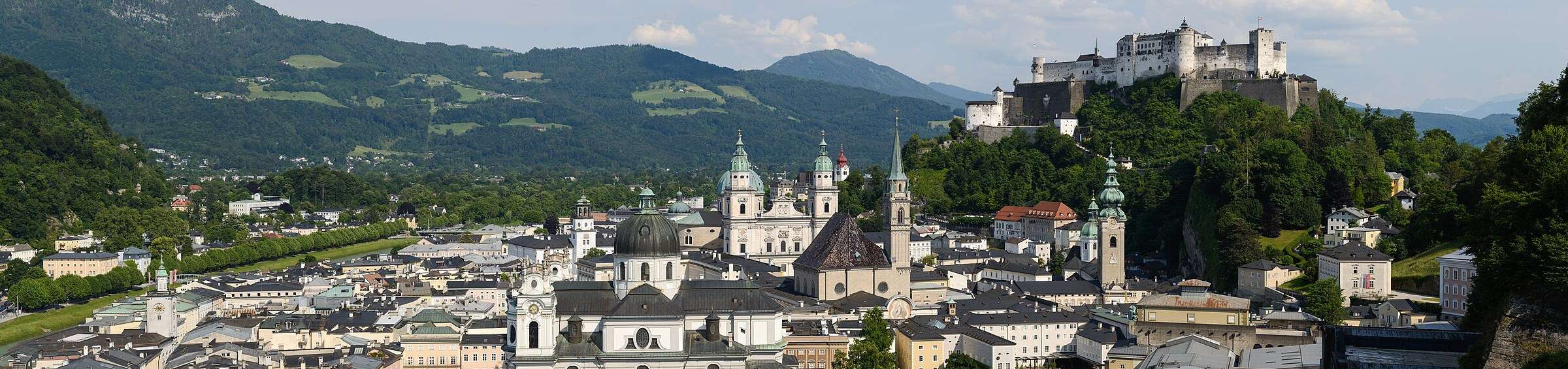
Salzburg’s hotels are mostly older than the music that made the city famous. This list has the Goldener Hirsch, an inn since 1407 that Countess Walderdorff ran as the Festival’s social headquarters, Schloss Leopoldskron, which Max Reinhardt restored as his private stage, the Gmachl family’s inn at Elixhausen, in their hands since 1334, and Schloss Fuschl, the prince-archbishops’ hunting lodge where the Sissi films were shot.
The list is grouped by character, not ranked. Each hotel’s name links to its own site, so you see the current rate and book direct.
Grand hotels and Festival society
Hotel Sacher Salzburg · Neustadt / Salzach riverside (Schwarzstraße)
The Sacher opened in 1866 as the Österreichischer Hof on the right bank of the Salzach, facing the Old Town. The Gürtler family, owners of Vienna’s Hotel Sacher, bought it in 1988 and renamed it Hotel Sacher Salzburg in 2000. It counts Festival conductors and singers among its regulars, by its own account, and serves the Sacher-Torte of its Vienna parent.
Hotel Bristol Salzburg · Neustadt / Makartplatz
The Bristol was built around 1890 on Makartplatz, across the square from the Mozart family’s Residence. The hotel’s own history names Emperor Franz Joseph I and Sigmund Freud among past guests. It bills itself as privately owned rather than a chain flag.
Hotel Goldener Hirsch, a Luxury Collection Hotel, Salzburg · Altstadt (Getreidegasse)
The house on Getreidegasse dates to 1407 and has been an inn for most of its life. Countess Harriet Walderdorff reopened it as a hotel after the Second World War and ran it as the Salzburg Festival’s social headquarters. It trades under Marriott’s Luxury Collection flag after a full restoration in the late 2010s.
Hotel Schloss Mönchstein · Mönchsberg
Schloss Mönchstein was first recorded in 1350 as the Tetelheimer Turm, a property of St Peter’s Abbey on the Mönchsberg plateau. From the seventeenth century it served as a summer retreat for professors of Salzburg’s Benedictine university, which gave it the name. It has been a hotel since 1948, with a wedding chapel in the tower and a clifftop park above the Old Town.
Castles, palaces, and a 700-year-old country inn
Hotel Schloss Leopoldskron · Leopoldskron
Schloss Leopoldskron was built from 1736 for Prince-Archbishop Leopold Anton von Firmian as a rococo family seat on the Leopoldskroner Weiher. Max Reinhardt, co-founder of the Salzburg Festival, bought it in 1918 and restored it as his home and private stage until the Nazis seized it in 1938. The Salzburg Global Seminar has been based here since 1947; the lake terrace appears in The Sound of Music, and hotel rooms opened in the Meierhof and the Schloss in 2014.
Rosewood Schloss Fuschl · Hof bei Salzburg (Fuschlsee, about 20 km east of the city)
Schloss Fuschl was built around 1450 as a hunting lodge for Salzburg’s prince-archbishops, on a spit of land in the Fuschlsee about twenty kilometres east of the city. Joachim von Ribbentrop, the Nazi foreign minister, seized it in 1939 after its owner was arrested; Romy Schneider’s Sissi films were shot here in the 1950s. It reopened in July 2024 as Rosewood Schloss Fuschl after a multi-year restoration.
Romantik Spa Hotel Elixhauser Wirt · Elixhausen (about 8 km north of the city)
The Gmachl family has run the inn at Elixhausen, eight kilometres north of the city, since 1334, which makes it widely cited as Austria’s oldest family business. It is now in its twenty-third generation under Michaela Gmachl, by the family’s count. The hotel was renamed from Romantik Hotel Gmachl to Romantik Spa Hotel Elixhauser Wirt; the Gmachl name lives on in the restaurant.
Inns of great age in the Altstadt
Arthotel Blaue Gans · Altstadt (Getreidegasse)
The Blaue Gans is an inn first documented in 1350 at the west end of Getreidegasse, and it claims the title of Salzburg’s oldest, with more than 660 years of hospitality. The owner Andreas Gfrerer turned it into an art hotel in the 1990s; well over a hundred works of contemporary art hang in the rooms and corridors, by the hotel’s count.
Hotel Elefant · Altstadt (Sigmund-Haffner-Gasse)
The Elefant is a family-run hotel in a house the owners date to more than 700 years old, on the lane named for the Haffner family, whose commissions gave Mozart the Haffner Serenade and the Haffner Symphony. The hotel ties its name to Soliman, the elephant said to have been led through Salzburg in 1552 on his way to the Habsburg court in Vienna.
Altstadthotel Weisse Taube · Altstadt (Kaigasse / Kaiviertel)
The Weisse Taube stands in a house on Kaigasse first recorded in 1365, a block from Mozartplatz and the Residenz in the quiet Kai quarter below the fortress. It has been family-run for well over a century, now in its fourth generation, by the family’s account.
Hotel Goldgasse · Altstadt (Goldgasse)
The Hotel Goldgasse occupies the former Gasthof Zur Goldenen Ente at Goldgasse 10, a lane of medieval burgher houses behind the Residenz. It reopened as a boutique hotel in the mid-2010s under the same owners as the Hotel Stein, and its restaurant says it works from recipes in Conrad Hagger’s 1719 Salzburg cookbook.
Right bank, river and Linzer Gasse
Hotel Stein · Salzach riverside (Staatsbrücke, right bank)
The Stein stands at the right-bank end of the Staatsbrücke; the hotel dates the inn on this corner to 1399. It was rebuilt from the ground up and reopened in 2018 with Venetian-inspired interiors and Murano glass by Barovier & Toso. The rooftop Steinterrasse bar looks across the Salzach to the Old Town and the fortress.
Stadtkrug Boutique Hotel · Neustadt / Linzer Gasse
The Stadtkrug stands on Linzer Gasse, the right bank’s medieval trading street, at the foot of the Kapuzinerberg. The restaurant serves beef from the family’s own organic farm, by the hotel’s account. It traded as the Altstadthotel Stadtkrug before taking its current name.
Leonardo Boutique Hotel Salzburg Gablerbräu · Neustadt / Linzer Gasse
The Gablerbräu has stood at the foot of Linzer Gasse since 1429, first as a brewery and beer hall. Brewing on the site ended in the twentieth century, but the name survives for the restaurant and the hotel above it. The hotel passed from the Star Inn group to Leonardo Hotels, which runs it under its Boutique label.
Hotel & Villa Auersperg · Neustadt (Auerspergstraße)
The Auersperg is two houses on Auerspergstraße, a villa from around 1900 and a larger hotel building, a ten-minute walk from Linzer Gasse. Bettina and Mark Wiesinger run it as a family hotel, and it is a member of Private City Hotels, the Austrian group of independent city hotels.
Frequently Asked Questions
Are these hotels ranked?
No. The groups sort them by character, and the order within each group carries no meaning.
What made a hotel interesting enough for this list?
A story. Every entry was a Festival-era grand hotel, a castle or palace with a documented past, an Altstadt inn of great age, or a right-bank house tied to Linzer Gasse. Comfort alone did not qualify.
Why are there no prices?
Rates change daily and a priced list goes stale in a month. Each hotel’s name links to its own site, so you see the current rate and book direct.
When do these hotels fill up?
The Salzburg Festival, from late July into August, fills the Altstadt inns and the Sacher many months ahead and lifts rates across the city. Advent weekends are the other peak. Outside those, the small Altstadt hotels book a few weeks out.
Which hotel puts me closest to the day trips on this site?
Most day trips from Salzburg run to Hallstatt and the Salzkammergut lakes, to Berchtesgaden and the Eagle’s Nest, to the Werfen ice caves, or around the Sound of Music locations. The Altstadt and right-bank hotels near the Staatsbrücke sit closest to the coach pickups at Mirabellplatz.